What you get back: the placement step, the words read correctly per minute about once a week, and a printable stage report. See the full sound sequence and an example report.
Every family you send gets one month free, no card. Pairs with Barton, Wilson, AAR, S.P.I.R.E. and LiPS. How it fits your program.
What happens at home, and what comes back to you
1CheckA free reading check finds the placement step.
2Decodable storyChild lines use taught sounds, plus a few words introduced with extra help.
3Weekly dataWords read correctly per minute about once a week, and a printable stage report.
What your families get
You work with the children this was built for. A New Page is a structured-literacy reading program families do at home for about 15 minutes a night, grounded in Orton-Gillingham principles: explicit, systematic, cumulative.
One month free
No card. One link, any number of families.
Details
No card, nothing to pay. Give it to as many families as you like. Anyone who signs up on their own gets 7 days; your link gives 30 days once the family shares their child’s reader with you in their first week.
Structured literacy at home
15 minutes a night, starting from the sounds the child knows.
Details
A story the child moves forward by reading the hero’s lines, built from the sounds they have been taught, about 15 minutes a night.
A weekly report you can use
One-minute reads, charted. Prints for your file.
Details
Starting level plus a quick one-minute read about once a week, charted against the child’s own trend. From the end of Level 8, a grade-level check-up on unseen passages adds a comparison with US national norms. The between-session data you would otherwise gather yourself.
After the first month
$29 a month, or state ESA funds where they apply.
Details
If it helps, families continue on their own for $29 a month or $299 a year, or pay with their state ESA or scholarship funds where those apply.
From TidewatchEpisode 1the 8 to 10 version“You held the chart in the warm lantern light and let your eyes walk slowly along the glowing marks, the way Tom taught you, never rushing, letting each one say its sound before you moved to the next.”
The short filmabout one minuteSee one night at homeA parent and a child reading a real story together.
Share a reader, three steps
See the same reader your family sees at home, on your own device.
The family sends you a code
They choose Share a reader on their child and send you the code.
Two ways to pass it on. Neither shares any student information.
One family, one month free
Send this to any family you work with. The link sets up one free month, no code to type.
Your therapist set your family up with one month of A New Page, free. It is a structured-literacy reading program to do at home about 15 minutes a night, and it picks up right where your child is. No card needed. Share your child’s reader with your therapist in your first week to keep the full month. Start here: https://anewpagereading.com/reading-program/join.html?tc=therapist
Free for you, with nothing to manage. When a family shares their child’s reader with you, the family’s access covers you: you read with that child free for as long as the family has A New Page, with no time limit and no card.
Using it with many students in a clinic? Write to us at jnclark@anewpagereading.com.
A whole class or newsletter, 7 days free
A short note for your email or newsletter.
Reading practice at home: A New Page is a structured-literacy reading program families do together at home, about 15 minutes a night. Your child reads the hero’s lines in a real story, matched to taught sounds and words introduced with extra help, and you read the rest from a script on screen. For ages 3 to 18. The first 7 days are free, no card needed: https://anewpagereading.com
This note and the handout use the public free week. For a family you work with directly, the link above gives one month.
A one-page handout for families
Plain words: what it is, what a night looks like, what it costs. Print it or attach it.
For reading specialists: A New Page pairs with the programs you already run
For the OG or LSL-trained clinician who wants to know, in one read, exactly how a nightly at-home program fits alongside a weekly specialist session. Straight answers.
The clinician summary (1 minute read)
A New Page runs an explicit, systematic, structured-literacy scope, built from what the child has already learned; the parent runs it at home 4 to 5 nights a week; we built the scope to sit alongside Barton, Wilson, AAR, S.P.I.R.E., and LiPS. Your weekly lesson stays the front door, we are the daily practice, and the parent hands you our weekly report.
Older students are differentiated, not shoehorned: a teen who still reads effortfully places into a self-directed track (their own register, no parent script, adult joins for the weekly check-in), while a teen who already decodes automatically and only needs word study and volume is told honestly that books, not our subscription, are the next intervention.
Pairs with the programs you already run
Barton
Wilson
AAR
S.P.I.R.E.
LiPS
Orton-Gillingham
Barton Reading & Spelling
How they overlap
Both are Orton-Gillingham lineage, explicit, systematic. Barton is scripted 1:1; A New Page is scripted parent-led. Sound layer, sequence, and accuracy-first discipline align.
Where we sit
Between Barton sessions, as the daily practice slot. A child at Barton Level 2 (CVC) maps to our Level 1 through early Level 2; Barton Level 3 maps to our Steps 2.14 to 2.16 (blends) and Level 3 (digraphs).
One caveat
Barton’s order for some patterns may differ from ours. Our placement is conservative by default and places at the first wobbly layer, so it will usually land a step or two below where Barton has them; let the child prove the ceiling upward.
Wilson Reading System / Fundations
How they overlap
Wilson is the school-based OG standard for tier 3. Same sound-symbol discipline; same fluency-after-accuracy stance; same emphasis on nonsense-word probing.
Where we sit
Nightly practice on the patterns your Wilson session introduced. We deliberately do NOT teach ahead; we consolidate. Fundations families can use us for nightly connected-text practice on the patterns Fundations has taught.
One caveat
Wilson syllable-type naming (closed, open, VCe, r-controlled, vowel team, consonant-le, diphthong) is not our on-screen vocabulary. Our scope page lists every pattern by step so you can map them.
All About Reading (AAR)
How they overlap
AAR is the homeschool-parent staple. Explicit phonics, decodable readers, hands-on. Same design philosophy as ours: assume no reading-specialist training in the parent.
Where we sit
Fine as the primary program at home, with AAR as the every-third-day slower lesson. Or vice versa: AAR as the primary, and we serve as the nightly decodable-story practice slot with progress reporting AAR doesn’t provide.
One caveat
AAR’s Fluency Sheets are excellent; we don’t replace them. Use both.
S.P.I.R.E.
How they overlap
S.P.I.R.E.’s structured lesson plan fits beside our nightly session, which has three parts: a warm-up (review, sound play and the new pattern), a decodable story, and word work with spelling. Both are Orton-Gillingham based.
Where we sit
S.P.I.R.E. session in your clinic; A New Page as the practice consolidation the four nights S.P.I.R.E. doesn’t reach. Our weekly report gives you the between-session practice data (nights read, accuracy, the words missed) to add to your own records.
One caveat
Our placement check starts the child at the pattern they actually need, which may be ahead of their S.P.I.R.E. level. Tell the family if you want home practice held to the patterns you have taught.
Lindamood LiPS (Lindamood Phoneme Sequencing)
How they overlap
Both take phonemic proficiency as foundational. We do not replicate LiPS’ articulatory-gesture front end (that is your specialty), but we honor the outcome: children who cannot yet segment or manipulate phonemes at 3+ sounds need PA-intensive work before decoding drills.
Where we sit
A LiPS client whose PA is not yet fluent should start our Level 1 with the extra sound-play flag on (our placement flips it automatically when blending is effortful). We become the connected-reading practice AFTER LiPS graduates them to decoding.
One caveat
Do not layer both simultaneously for a young client if PA is still fragile; it doubles the phonemic demand. Sequence: LiPS first, us after.
Orton-Gillingham (generic, not brand-specific)
How they overlap
Everything. OG is our lineage. Our sound-symbol sequence, mastery gating, spaced retrieval, decodable connected reading, and cumulative review are OG principles put in a parent’s hands.
Where we sit
Nightly practice slot; parent hands you our weekly progress note; you use the note in your next OG session.
What you get automatically, for every client family you referShare a reader, the reading check summary, the weekly report, one month free, the Diagnostic Gap Kit, and an example report
Home and clinic, one record, with Share a reader.The family runs the nightly sessions at home and you see the same reader they do, in the three steps above. One code per child; stop sharing any time.
The reading check summaryLetter-sound survey, blending, real and nonsense words, spelling probe and a listening comprehension check-in, as a printable, dated one-page summary framed on the Ladder of Reading.
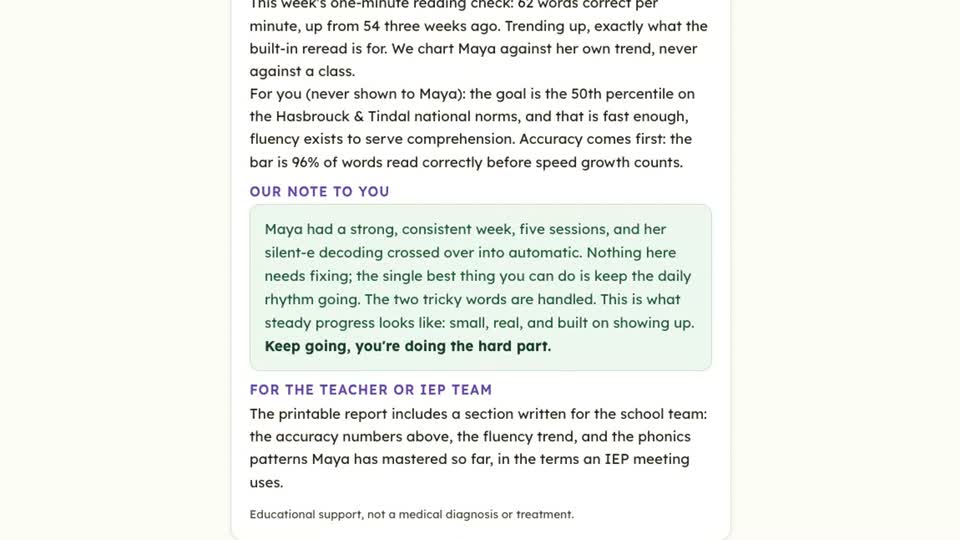
The weekly report, written in school-team languageAccuracy first at a 95 percent bar, own-trend fluency growth on instructional-level passages (never norm-compared), a Hasbrouck-Tindal comparison only from the grade-level check-up on unseen passages, patterns mastered, patterns coming next, an honest disclaimer, and a stated validity note that formal grade-level ORF belongs to an unseen grade-level passage.
One month free for families you send through your linkhttps://anewpagereading.com/reading-program/join.html?tc=therapist
The Diagnostic Gap KitA pre-filled Child Find request letter (for families in the United States), a reading check summary, and one month of free at-home practice while a public-school evaluation is under way. Open the kit.
What we tell families ourselves: reading practice alone is not always enough. A child with ADHD and dyslexia needs both addressed, an underlying spoken-language issue slows decoding no matter how strong the phonics, and English language learners need language support alongside reading instruction. When your clinical picture says a second intervention belongs in the plan, we will have already said the same thing to the family in plain language.
Where it stands, honestlyLive today for families; the specialist and clinic roster; the school pilot and district stages
A New Page is a parent-and-child reading program today. We’re building the versions educators have asked for, and honestly, we need your help to get them right. We’d be honored to build them alongside a few great schools, specialists and clinics, shaped by the people who do this work every day.
Daily structured-literacy practice that connects school, specialist, parent, and child.
Live todayFamilyParent-guided, child-centered structured-literacy practice at home, explicit phonics, decodable stories the child reads, dictation, and a weekly progress report. We’re new.
First pieces live · early partners nowSpecialist & ClinicThe caseload roster is live today: every student's level, streak, this-week reading, and watch-list on one printable screen, and daily between-session practice runs from any device. For the home side, use Share a reader: the family chooses Share a reader on their child and sends you the code, you type it at anewpagereading.com/r and sign in with your own email, and you both see the same step, story and weekly report. Reading with a shared reader is free for you for as long as the family has A New Page. Using it with many students in a clinic? Write to us. Progress pulls formatted for school meetings are next, shaped by our early partners.
Pilot, by invitationSchool pilotA small-group, 8-week intervention pilot (Tier 2/3, resource room, after-school, summer bridge) with a teacher view and a parent bridge home. Supplemental practice, not a core curriculum, yet.
LaterDistrictRostering, admin reporting, SSO, privacy/security documentation, and implementation support, built once the pilots bear it out.
Why educators are interestedBuilt on the standards you use, real decodability, dignity for older readers, progress you can act on
Built on the standards you useStructured Literacy, aligned with the IDA Knowledge & Practice Standards and the science of reading. The full research base is public: the evidence & references → And so is the curriculum itself: the complete scope & sequence →
The decodability is realChildren only meet phoneme, grapheme patterns they've been taught, plus the irregular words taught explicitly first, never guess-from-the-picture. What a specialist does, and how we bring it home →
Older readers get dignityA struggling 14-year-old gets an age-appropriate adventure at their real reading step.
Progress you can act onA weekly report with curriculum-based oral-reading-fluency data, appropriate to share with a team, framed as progress monitoring, never a diagnosis.
Our claim discipline. A New Page is built on and aligned with these methods and standards. We have not yet run an independent study of this program, and we won’t claim outcomes we haven’t earned. Building that evidence, through expert review and pilots with early partners, is exactly the work ahead. If you’d push back on any of it, we want to hear it.
Be an early partner
Tell us about your students. We’ll follow up personally, no automated sales pipeline, just a conversation.
Thank you
We've got it. As an early partner you'll help shape this, and we'll be in touch personally, soon.
Optional. Leave your email and we will send you the one-page overview and let you know as we add features for the families you refer. We never share your address.
A New Page is educational support, a complement to your work, not diagnosis or therapy and not a replacement for it. It is not a diagnostic tool and not a replacement for tier-3 specialist instruction. If your clients need help finding a certified specialist, our sister project A New Story keeps a vetted list.
From The Endurance LogTrue historySeason 1, Episode 7the 11 to 18 version“Then on the twentieth of August the sky does something impossible. The icebergs along the horizon lift off into the air and begin to change shape.”
True stories from history, built the same way. More are coming soon.